
What Are Data Islands in Construction and How Much Do They Cost Mid-Sized Contractors?
Data islands are the disconnected systems that force mid-sized contractors to use 8–10 different apps. The result? Wasted hours, conflicting reports, and lost revenue. Contractors typically lose 10–20 hours per week and miss 15–25% of potential bids because of this fragmentation.
If you run a mid-sized specialty trade contracting business, you probably feel it every day: information about your customers and projects is scattered across too many systems.
The result?
- Wasted time hunting for the latest numbers
- Conflicting reports between sales, project management, and accounting
- Missed revenue opportunities because no one has the full picture
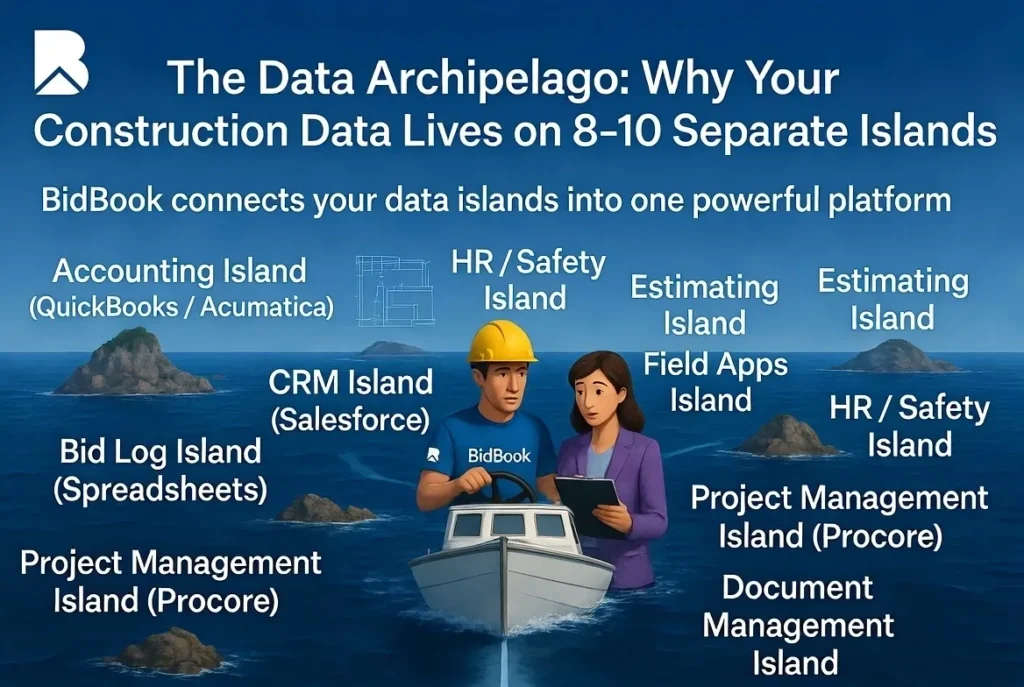
This fragmentation is known in the industry as “data islands.” Or YOUR Data Archipelago: the number of islands in your organization. And, it’s pervasive.
How Many Different Apps Does a Typical Mid-Sized Contractor Use?
A typical mid-sized construction contractor (20–100 employees or $10M–$100M+ in annual revenue) relies on 6 to 12 different software applications to track customers and projects. (Source: Raymon Howington’s interview with 100’s of construction business owners and surveys. JB Knowledge Surveys)
Most common range:
- Typical fragmented setup includes: 8–10 applications
Here’s what that tech stack usually looks like:
- Accounting / Job Costing (QuickBooks, Acumatica, Sage, etc.)
- Project Management (Procore, Buildertrend, CoConstruct)
- CRM or Sales Pipeline (Salesforce, JobNimbus, or spreadsheets)
- Bid Management / Estimating (Excel, BidBook, or dedicated tools)
- Takeoff & Estimating (PlanSwift, Bluebeam)
- Field Apps (time tracking, daily reports, photos)
- Document Management (Dropbox, SharePoint)
- HR / Payroll / Safety tools
Each tool solves one piece of the puzzle—but none of them talk to each other well. And some apps are used in areas not inteded. For example, ledger based accounting applications used for sales process automation.
Why Data Islands Are So Expense ?
When your customer and project data live in isolated systems, you get:
- Multiple versions of the truth — Sales thinks a job is at $1.2M; accounting shows $980k after change orders.
- Poor forecasting — Impossible to answer “How much will we invoice next quarter?” with confidence.
- Double-counted bids — The same opportunity appears in multiple spreadsheets, inflating win probabilities.
- Slow decision-making — Project managers and estimators waste hours copying data between systems.
- Revenue blindspots — You can’t easily see potential revenue, contracted backlog, invoiced amounts, and targets in one place.
These problems result in $65,000 software overspend per year plus $300,000 in manual efforts, rework and mistakes.
Read the post “What is the True Cost of Data Islands in Construction” for a drill down on the numbers.
This is exactly why so many contractors struggle with how to manage construction bids, backlog visibility, and cash-flow predictability.
How Does BidBook Solve Data Islands and Give You One Source of Truth?
The good news? You don’t have to rip out every tool and start over.
BidBook is built as flexible construction CRM software and construction bid management software that fills the gaps exactly where you need it most.
You can start small and grow:
- Use BidBook just for your bid log and project estimation tracking to begin with
- Add backlog and revenue reporting when you’re ready
- Connect invoice summaries from QuickBooks or Acumatica for full visibility
- Gradually replace spreadsheets and fragmented CRM tools as your team sees the value
Many contractors begin with BidBook as their pre-construction CRM or project bid tracking tools and later expand into full cloud construction CRM capabilities. There’s no pressure to boil the ocean on day one.
Benefits of Reducing Data Islands
- One version of the truth across sales, estimating, and project teams
- Real-time visibility into bids, backlog, and revenue targets
- Better CRM tools for contractors that actually support how contractors manage project bids
- Improved cash-flow forecasting and resource allocation
- Less time spent copying data, more time winning work
Whether you’re a small contractor looking for construction CRM for small contractors or a growing firm evaluating Salesforce CRM for construction companies or the best bid management software for contractors, reducing data islands is one of the highest-ROI moves you can make.
How to Start with BidBook Reducing Data Islands ?
- Start migrating your bid log to BidBook
- Send your CSV or XLS or Google spreadhseet to BidBookSoft to import a sample for free
- Use BidBook to drive your bid review meetings with estimation
- Turn on backlog & forecasting
- Connect accounting to receive invoice summary data securely by project number
- Enable real-time dashboards
Ready to Start Consolidating Your Tech Stack? Schedule a quick demo and see how BidBook can replace multiple tools—starting with whatever pain point is costing you the most time and money right now.
FAQ
What is an Archipelago ?
Coined by BidBookSoft founder, Raymon Howington, an archipelago is a group of islands scattered in bodies of water, ocean, often formed by volcanic eruptions or tectonic plate movements. In context to software applications, they refer to a group of discrete, disconnected, islands of data used within an organization including spreadsheets. Data islands appear like gopher holes eruptions to address challenges quickly and without thought to overall company design and impact to others (band-aids). Thus, are you a Bermuda Island or Bahamas data archipelago? Are you built on solid foundation or a volcanic hazard zone?
How do I know if my company has a data islands problem?
This might sound like a dumb question but people are often surprised when they go through the exercise of inventorying application tools. The larger an organization becomes, the more silo’d workers become creating distance in how others work. Even business owners may find that staff have found their own work-arounds or worse suffer “administrivia”, administrative tasks performed inefficiently. Raymon Howington, Founder of BidBookSoft, created a PRACTICAL method for mapping a business process as part of its CRM Peak Performance methodology. A DIY (do-it-yourself) method is shared on the BidBookSoft Events page that not only will help you inventory the applications used in your business’s processes, but will also accelerate continual innovation and adoption of organization wide AI solutions.
How long does it take to implement BidBook and consolidate data?
3 working days to spin a database, collect/review your data, import and present it back to you.
Can BidBook work alongside my existing tools like QuickBooks, Procore, or Accumatica?
Yes, packaged connectors exist for all three.
What is the typical ROI when fixing data islands?
Were wrapping up an ROI calculator soon. Subscribe below. Or connect to our LinkedIn Company Page.
Is BidBook only for general contractors or specialty trades ?
Both. The Bid Log is typically referencing a trades’ or specialty contractor business model. Each business model has its own business processes and challenges that BidBookSoft uniquely addresses.